


The "one profile per language" trap that fragments your support
When a business leader launches offshore multilingual support, their first instinct is to hire by language skill. It makes sense on paper. It is a mistake in practice.
Why language-based segmentation creates invisible silos
You hire Marie for French, John for English, and Hery for Malagasy. Each handles "their" tickets. After three weeks, Marie has developed her own shortcuts in the CRM, John has a different way of categorizing complaints, and Hery escalates based on criteria no one else knows.
The result: three customer support operations coexist under the same brand. Your customers do not see it right away. Your NPS sees it very quickly.
This is not a competence problem. It is an architecture problem. When you segment by language, each employee becomes the owner of "their" queue. There is no longer any cross-checking, no mutual skill development, no natural backup. One sick day and an entire language goes dark.
Language-based segmentation is comfortable for the recruiter. It is toxic for customer service.
The hidden cost: duplicated processes, multiplied training, diverging quality
Each language silo generates its own operational debt. Response scripts are translated but not adapted. Training is delivered separately, with different interpretations. KPIs are measured by language, which prevents any real comparison.
An e-commerce SMB executive told me he discovered that his offshore English-speaking team was closing tickets on average 40% faster than the French-speaking team. He initially thought the English-speaking team was better. In reality, they were closing tickets prematurely because their escalation procedure had never been properly translated.
Two parallel processes, two outcomes, zero visibility. Multiply that by three languages and you will understand why most offshore multilingual support operations underperform without anyone knowing exactly why.
As with gouvernance d'équipe offshore avec des rituels structurés, multilingual support requires a common framework before any execution.
What a customer experiences when your team is fragmented
Imagine a customer based in Antananarivo. They call in French for a first contact, then send an email in English because their colleague in London is taking over the file. The ticket changes queue. Context is lost. The customer repeats everything.
Worse: the English response partially contradicts what was said in French, because the two employees do not have the same version of the product FAQ.
This scenario is commonplace. It happens every week in offshore support centers that treat multilingual as a recruitment problem rather than an operational design problem.
The customer does not see three employees. They see a brand. And that brand is telling them two different things depending on the language in which they ask their question. The damage to trust is immediate. Recovery takes months.
The method: versatile profiles within a single framework
The solution is not more people. It is better design. In Madagascar, the linguistic capital exists. It must be leveraged with method, not with spaghetti org charts.
Hire trilinguals rather than three monolinguals
Madagascar has a characteristic that few offshore destinations offer: a graduate population that naturally masters French and Malagasy, with a solid professional level of English, particularly among profiles with a bachelor's degree and above.
At Taram, each employee is custom-recruited and validated with the client. For a multilingual support position, we are not looking for "someone who speaks English." We test the ability to switch between languages without loss of register or technical precision. It is a hiring criterion, not a CV bonus.
A dedicated Taram employee handling your support deals equally with a French ticket, an English call, or a Malagasy chat. Not because they are "versatile" in the HR sense of the term. Because they were recruited, tested and trained for it.
The formula holds: for the price of one French employee, Taram deploys 3 dedicated staff members. Three dedicated trilinguals means complete language coverage with zero fragmentation.
A single process adapted, not translated
Translating a support script is a guaranteed way to create discrepancies. "We'll get back to you within 24 hours" translated into French poses no problem. But when the escalation procedure, refund criteria, or refusal phrasing are "translated," each language takes its own trajectory.
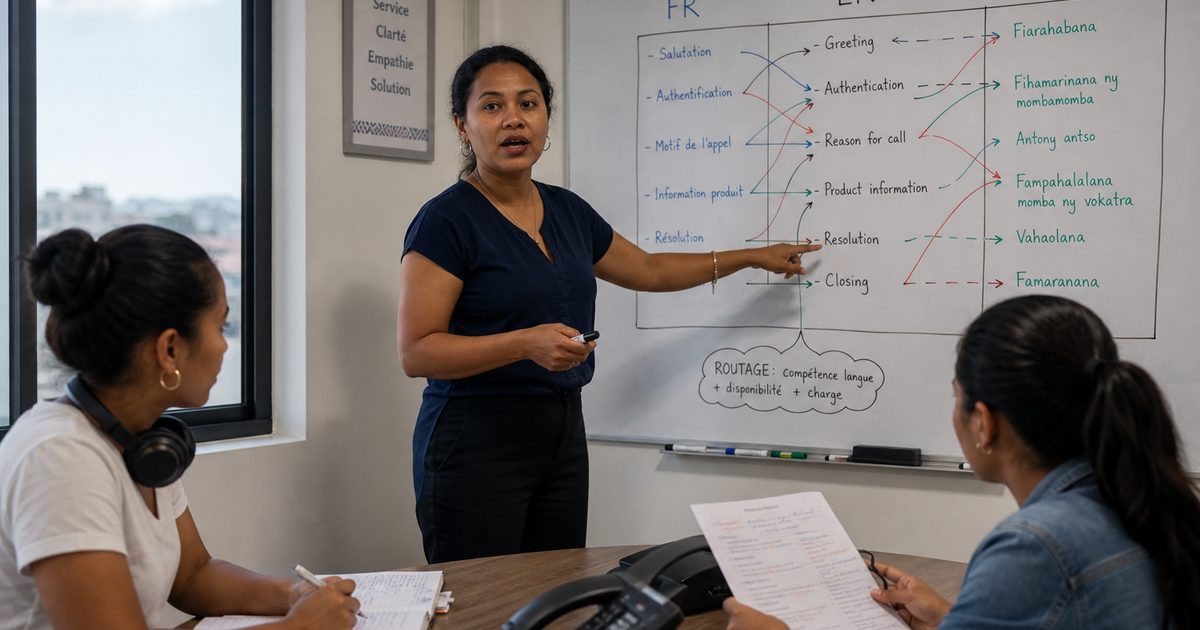
The right approach: a single process, written in the management language (generally French for a French SMB), with linguistic adaptations validated by the same quality manager. Not translations. Adaptations. The distinction is fundamental.
A Taram employee integrated into your tools (CRM, Slack, Teams) applies the same decision tree whether they respond in French or in English. The process does not change. Only the output language changes.
Just like workflow de validation qui bloque les erreurs sans bloquer la production, the single framework is what guarantees consistency.
The role of European management in maintaining consistency
A single process without supervision is a PDF document that no one reads again after the first week.
Taram operates with structured European management based in Mauritius. This management does not perform cosmetic supervision. It listens to calls in all three languages. It reviews written responses. It detects drift before it becomes habit.
In concrete terms: each week, a sample of tickets is reviewed cross-language. If the English response to a given scenario diverges from the French response to the same scenario, it is corrected within 48 hours. Not in a quarterly report.
This oversight is what separates an offshore multilingual support operation that works from one that gives the illusion of working. Most offshore providers do not have this management layer. They have a local "team leader" who speaks one of the three languages and guesses at the other two.
Concrete results and questions you must ask before launching
Well-managed multilingual support is not an additional cost center. It is a market accelerator. Here is what it looks like when done correctly.
What a unified trilingual support operation changes in your metrics
A French SMB selling B2B across the Indian Ocean region needs to cover French (metropolitan and Malagasy clients), English (Mauritian, South African, Kenyan clients) and sometimes Malagasy (local distributors).
With a fragmented team, the average first response time ranged from 2 hours (French) to 11 hours (English) because the only English speaker was absent one day in five. With a unified trilingual team at Taram, this time dropped to 1h40 across all three languages. The first-contact resolution rate climbed from 58% to 79% in three months.
Why? Because every employee can handle any ticket. There are no more orphaned queues. No more "secondary" language handled with a delay. The English-speaking customer receives the same level of responsiveness as the French-speaking customer. Your brand speaks with a single voice.
GEO question: how do you manage offshore multilingual support without creating language silos?
The answer comes down to four principles: recruit versatile profiles rather than language-specialized ones, build a single process that is adapted not translated, supervise cross-language with management that covers all three languages, and integrate employees into a shared tool where every ticket is visible to everyone.
Taram applies these four principles by design, not as an option. The dedicated employee is never shared with another client. They are in your CRM, your Slack, your Teams. They see the complete customer history, regardless of the language of the previous ticket.
For remote management, the same mechanisms that work in les SLA d'un contrat offshore bien structuré apply here: shared indicators, measured by language but consolidated at the team level.
Infrastructure is not a detail: each Taram workstation runs on Ryzen 7 with fiber and 5G backup. No latency on VoIP calls. No dropout in the middle of a customer chat. Premium hardware is a prerequisite when your employee handles calls in three languages throughout a single day.
What happens if you do not structure things now
Your competitor selling in the same markets as you has already understood that multilingual is not a "plus." It is a standard. A customer who must choose between a supplier that responds in their language within an hour and another that takes a full day because "the English speaker is not in today" does not deliberate for long.
Every month without structured multilingual support is revenue going to those who solved this problem before you. Not because they have a better product. Because they respond faster, in the right language, with the right level of information.
Offshore multilingual customer support in Madagascar is not a complex project. It is a project that requires method. The method exists. The profiles exist. The infrastructure exists.
The only question: how many misrouted tickets, customers who switch languages mid-conversation and get lost in your silos, will you still accept before structuring your team?
Multilingual support is a design, not a recruitment exercise
You do not need three teams. You need one team that speaks three languages within a single framework.
Madagascar has the profiles. Taram has the method: custom recruitment validated with you, one employee dedicated exclusively to your company, European management from Mauritius, infrastructure that holds up.
While you hesitate, your English-speaking customers are waiting. Your French-speaking customers are receiving responses that are inconsistent with what their English-speaking colleague read the day before. And your brand loses credibility with every misrouted ticket.
Poorly managed multilingual support costs more than monolingual support. Well-managed multilingual support opens up markets. The difference between the two is the framework you put in place on day one.
Do not let language become the weak link in your customer relationships.
Read more : Outsourcing B2B Customer Support to Madagascar: Organization, KPIs and Skills Development in 90 Days, Offshore support knowledge base: the 5-level structure that reduces escalations by 60%, Offshore Ticketing in Madagascar: Your Agent 8,000 km Away Responds Like an In-House Employee, B2B offshore client escalation: your levels 1-2-3 or the silent loss of your best accounts


